The starting point
HappyScribe turns audio and video into text: transcription, subtitles, and translation, done by AI or by professionals.
The people who need that rarely search for “transcription software”. They search for the job in front of them: MP3 to text, add subtitles to video, convert video to audio. That’s thousands of small, specific searches, each with clear intent.
So the goal was simple to say and hard to do: have a genuinely useful page for each of those jobs, on a site structure that could keep growing without breaking, and then make sure the pages that bring in customers could win against bigger competitors.
The work ran in two phases. From 2020 to 2021 I worked in-house, building the foundation. From 2021 to 2023 I kept working on the account as an external SEO partner, focused on links and on the pages that drive revenue.
What we did
1. A site migration that kept the rankings
Before building anything new, the site had to move. Migrations are where SEO traffic is most often lost, so it was planned like a launch, not a deploy.
- A full URL inventory. Every URL with traffic, rankings, or links, pulled from a crawl, Search Console, analytics, and backlink data. If a URL mattered, it was on the list.
- A one-to-one redirect map. Each old URL pointed to its closest new equivalent with a 301. No redirect chains, and no sending everything to the homepage.
- Checks on staging before launch. Redirects, canonicals, robots rules, XML sitemaps, titles and meta on every template, and internal links updated to point straight at the new URLs.
- Launch day and after. A fresh crawl of the live site, redirect hits checked against the map, Search Console watched for crawl and indexing errors, and rankings for the top pages tracked daily until they settled. Anything broken got fixed the same day.
2. Programmatic landing pages by format
Instead of one generic “transcription” page trying to rank for everything, we built a page for each job and each format: audio to text, video to text, MP3 to text, MP4 to text, and the same idea for subtitles and translation.
Here’s how it worked:
- Find the patterns. Keyword research grouped thousands of searches into a handful of patterns, like [format] to text, transcribe [format], or [format] subtitles. Each pattern became a page template.
- Templates with real substance. Swapping one word on an otherwise identical page creates thin, duplicate content that Google ignores. So each template pulled in format-specific content from structured data: what the format is usually used for, how to get the best result from it, step-by-step instructions, and its own FAQs.
- Hubs and internal links. Category hubs (transcription, subtitles, translation) link to every format page in them. Format pages link to related formats and back to their hub. That structure is still visible in HappyScribe’s footer today.
- Quality control at scale. Pages only went live where there was real search demand. Index coverage was monitored, and pages that didn’t earn traffic were improved, merged, or removed.
- Built to convert. Every page was designed to lead into the product, so someone searching MP3 to text could go from the search result to a transcript.
By the end of 2021, Ahrefs already counted more than 8,000 HappyScribe pages ranking in Google.
3. Free interactive tools
Next to the landing pages, we built small free tools that each do one job: converting, compressing, or fixing audio, video, and subtitle files. HappyScribe still runs a free tools section today, with things like a video to audio converter, video and audio compressors, and a subtitle time-shift tool.
Free tools work for SEO in a few ways at once:
- They match high-volume searches from people already working with audio and video files. That’s exactly HappyScribe’s audience.
- They earn links on their own. People link to useful free tools far more readily than to product pages.
- They boost engagement. Visitors use the tool instead of bouncing, and many come back the next time they need it.
- They’re a natural first step into the product. After converting a video to audio, the next step is often transcribing it.
4. SEO as part of the product team
None of this was a list of recommendations sent over the wall. Templates and tools were specced like product features, with clear requirements and acceptance criteria, built by the engineers, and measured after launch. Working this closely with engineering is what made it possible to ship thousands of pages and several tools without the quality falling apart.
5. Links to the pages that make money
With the foundation in place, the second phase focused on the pages closest to revenue.
- Pick the pages that matter. We looked for high-value pages where the top-ranking competitors simply had more backlinks, and estimated how many good links each page would need to compete.
- Model the revenue first. For each candidate page we estimated the sign-ups and new MRR it could bring in if it ranked. That decided the order, so link building went where it would pay back fastest.
- Relevant links, every month. New links were secured month after month from authoritative sites in relevant niches, with a natural mix of anchor texts, adjusted as results came in. Relevance came first, always.
- Content worth linking to. We created topically relevant content around HappyScribe’s core use cases and personas and pitched it to those sites. For example, one link to the audio to text converter page came from a site with a Domain Rating of 61.
- Two languages. The off-page work covered both English and Spanish.
- On-page alongside. We worked with HappyScribe’s own SEO team on meta titles and internal linking for the target pages, and kept suggesting content and technical improvements.
Results
During the project:
- Organic sign-ups on the targeted pages grew about 25× between February 2021 and November 2023.
- The cost per organic sign-up fell almost 90× between 2021 and the end of 2023.
- HappyScribe reported a CAC payback of less than one week.
- Ahrefs’ estimate of organic traffic, which starts in December 2021, grew about 5× by the end of 2023.
And after it ended, the foundation kept compounding:
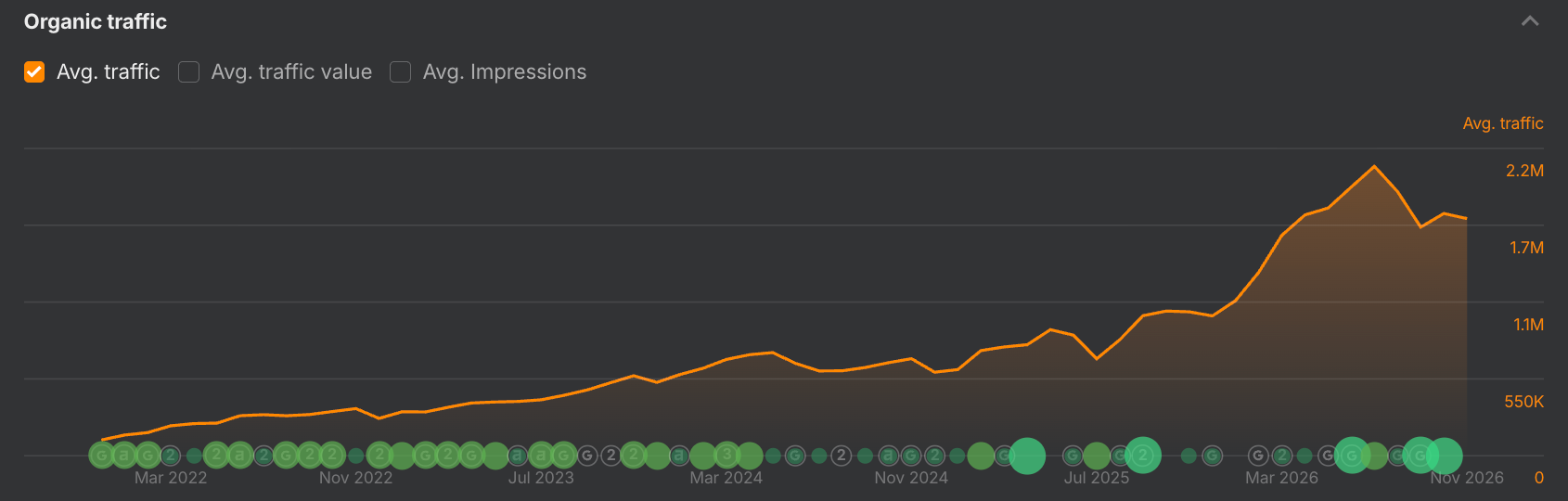
Estimated organic traffic for happyscribe.com, December 2021 to November 2026. Source: Ahrefs. These are Ahrefs estimates, not HappyScribe’s analytics.
By late 2026, estimated organic traffic was about 15× the December 2021 level, with a peak close to 20× in mid-2026. That’s more than three times what it was when the project ended.
To be fair about it: the growth since 2023 also reflects the work of HappyScribe’s team, and plenty of Google updates along the way. But the structure built back then, format pages under category hubs plus free tools, is still how the site is organized today.
What made the difference
- Building pages for the job people search for, not for the product category.
- Templates with real substance, so programmatic pages didn’t turn into thin content.
- Free tools that earn links and engagement on their own.
- Links aimed by revenue, not by volume: the pages with the most sign-up potential came first.
- A structure that scales. New formats and tools slot into the existing hubs, so the site kept compounding after the project ended.